
creative energy and hard work
February 18th, 2013
It’s funny how creative energy concentrates itself into bursts of powerful inspiration and accomplishment. Even more interesting is how it often follows long periods of uninspired or unsuccessful art work. Recently, I found myself teaching, being a mom and wife, juggling other professional and civic obligations and somehow managing to finish a long overdue ceramic and mixed media teapot, a Louise Nevelson-inspired assemblage, a series of lampwork bead pairs for earrings, and some much needed jewelry restringing, refurbishing, and new design creation. Still, I am itching to finish a couple more projects. I’m excited because after much uninspired sketching, mulling, and planning, I’ve at long last come upon inventive and original ways to get the work done.
Inspiration is for amateurs. The rest of us just show up and get to work. If you wait around for the clouds to part and a bolt of lightning to strike you in the brain, you are not going to make an awful lot of work. All the best ideas come out of the process; they come out of the work itself.
Chuck CloseProcess is a primary source of inspiration for me. A sense of inventive play while folding, cutting, and assembling clay slabs provides a stream of new information with which to work.
Margaret Bohls
Like lightning, these sage words from two accomplished artists have struck me in a serendipitous way. Close’s sentiment is a quote I’ve long held dear. Bohls’ statement was part of an article I recently read aloud to my ceramics classes. Both quotes affirm the importance of consistent work and I feel rewarded for thinking and believing them, even when my work had hit a bit of a rough patch. This is a concept that is difficult to get most young art students to accept and implement: The act of daily work, the creative process, and the ethic required to persist in these efforts is where inspiration lives. Of course, I have students who work every day. I have students who pay attention to detail, who get on with the act of working on projects, and who adapt and change as new creative problems arise. These are the students who create work admired by others. These are the students that other students hold in awe. Nonetheless, there’s a cognitive disconnect that occurs between understanding that Amazing Art Student is amazing simply (most of the time) because he or she does. The. Work. Every. Day.
I had a student remark on my recent flurry of work, “Mrs. Watson, why are you so good at everything? How do you do so much?” My reply was honest and short, “Well, I just keep at it every day. Most of these projects have been in my creative pipeline for months. One, for years.”
I think a lot of well-meaning people glorify the work of artists without really understanding the unbelievable lifetime of hard work that accompanies successful art. People look at the work of Chuck Close, throw their hands in the air, lament they can’t draw, and package the life and work and sacrifice of artists like him into a mystical, unattainable, instantaneous act of inspiration. If instead, we legitimized the creative process as daily work, as the result of a strong work ethic then I think we would lead more realistic and artful lives and place greater importance on the teaching and learning of art. Certainly, it would lend more credibility to the pursuit of art as a professional endeavor.
Indeed, inspiration still strikes, but almost always after a period of work or struggle. To help my students understand, I liken the experience to the work that an athlete does: Can you imagine a professional athlete who only shows up for the game? No practice, no training, no self-discipline? They can’t imagine it. Only then, do they begin to understand what I mean when an artist must show up and work, if not every day, consistently over time.
So today, I rest, reflect, and prepare for the work that lies ahead.
copyright ©2008‑2019 carol j watson
youth art month musings:
the importance of art education
February 16th, 2010
This article will make its official debut in the March 2010 of Austin Family Magazine and website. Be sure to pick up a copy at a location near you!
When people find out that I am an art teacher, certain responses are predictable: “Oh, I’m not good at art,” or “I can’t draw,” or “Be glad I’m not in your art class!” These comments are unfortunately common and depending on the situation, I debate internally whether to simply accept their statement as fact, politely encourage them with an optimistic remark or engage in a conversation about their experiences with art. Regardless of my decision, one thing routinely, painfully, becomes clear: Little I say will sway them from their negative opinion of themselves as artists.
Simultaneously, these self-proclaimed non-artists often wax poetic about their desire to be artistic, yearning for that nebulous Art Talent which they themselves never attained. I wonder at what point these people lost sight of their artful lives. Ironically, these folks also speak of few or sporadic art classes and experiences growing up. Or, they refer to art experiences limited to “coloring inside the lines” at the behest of their well-meaning homeroom teacher. In the absence of rigorous and dedicated art education, their idea of art and what art is grew stunted and uninformed.
On the other hand, individuals who actually had art class in school on a regular basis confide in me that they view their artistic ability as average or above. Furthermore, if they connected even only a little with their art teacher, they were deeply and positively impacted in a constructive and permanent way. Art is seen as something more than the ability to draw; art is a lens with which they view life. Over and over I hear from people I meet, see from students I teach, that art is the glue that connects the many different parts of their lives. Artful or creative thinking adds interest and innovation in an otherwise dull day at the office. Some days I am certain that it is my art class that made a particular student rise out of bed and come to school.
There is something special about arts education during the formative years of youth. More than just an “extra” in a child’s day, art is an essential component in developing a child’s ability to see the world around her in a critical, qualitative, and affective way. More than just learning how to draw, art education teaches a child to see, to perceive and to represent her environment, ideas, and responses in a variety of ways. More than just creating a sculpture or painting, art education compels a child to be in touch with her emotional and intellectual motivation for making certain aesthetic choices. The young artist must articulate what is often more easily represented with images, colors, textures or form.
Furthermore, research continues to show us that students receiving a fine arts education perform higher on standardized tests such as the SAT, enter the working world better equipped to meet the demands of 21st century employers and support the arts as an economic force in their communities.
Texas for The Arts lists in a PDF file no fewer than 20 reasons as to why Texas’ economy depends on the arts and the creative sector.
The Texas Commission on the Arts provides data on the future of arts education (visual arts and performing arts) as seen through the eyes of CEOs and other business leaders. Repeatedly we are being forewarned that creative thinking, innovation and communication are qualities needed for the 21st century workforce, and that exposure and interaction with the arts is one of the main components of a 21st century education.
The Texas Art Education Association features on its website compelling work by Elliott Eisner entitled “Ten Lessons the Arts Teach.” It is on display in my art room, shared by my peers in art and art education, read to my students and shared with parents and is an invaluable reminder of why art education and Youth Art Month are critical components in the whole education of any child. For the parent, grandparent, educator or advocate, it is invaluable articulation of why art education is important in our schools. Eisner’s list empowers those who wish to seek, protect and demand more art instruction in schools and communities.
TAEA also promotes March as Youth Art Month on its website, and provides resources for teachers and parents interesting further promoting art education year round. Students from around the state of Texas have an opportunity to create flags promoting Youth Art Month. Winners are featured on the website. The theme for Youth Art Month for 2010–2014 is “Art Shapes the World.”
The Council for Art Education, the official sponsor of Youth Art Month, highlights many of the benefits of art education and quality art programs in schools. Enhanced self esteem, creative problem solving, and appreciation of others are cited as some of the many benefits of art education. Youth Art Month, observed yearly in March, is a time for appreciation of art and art programs locally, regionally and nationally. Anyone can contribute to the month’s events and your local art teacher is a great place to start when seeking art appreciation opportunities. Through consistent and dedicated support of art education,parents, grandparents, teachers and schools can make a positive difference in the artful lives that children lead.
I know that even as an impassioned art teacher, there is little I can do to change a person’s experience with art in the past. Regardless of where a person might fall on the creative curve, there is one thing that anyone can do: Ensure that every child’s educational future consists of rigorous, extensive and protected arts education.
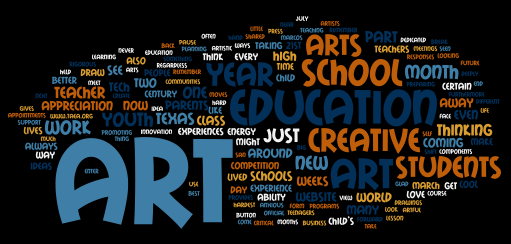
copyright ©2008‑2019 carol j watsonwordle!
April 16, 2010
 copyright ©2008‑2019 carol j watson
finishing-touches
February 15th, 2010
Whew, what a school year it has been! Better than ever, busier than ever with more talented students, more challenges in every way and every day. For months now we’ve been preparing for our big dance, V.A.S.E. (Visual Art Scholastic Event, see TAEA), on February 27th. I get to take 25 of my best, brightest and – ahem – most academically eligible art students to this competition held again at San Marcos High School in San Marcos, Texas. This year, they’ve worked on self portraits, still life drawings and gesture drawings, and now it is coming down to the wire. Less than two weeks away, we’re staying after school late and coming in to class early, putting the finishing touches on the work destined for judges’ hands.
The best part is by far the look of achievement on students’ faces when they hand me a finished work and we get to mat it for competition. Not normally driven by competition, this event moves me. I love the challenge my students face: conceiving a project idea, seeing it through to the end in whatever form it winds up taking, thinking deeply as they create, connecting their ideas to elements and principles of art, facing a judge, and lastly, coming away with feedback, experience, and a better understanding of themselves as artists.
I’ll post more about this experience as it unfolds. But for now, I am busy cutting mats, spraying fixative, and reassuring nervous students’ and myself.
copyright ©2008‑2019 carol j watsonride the wave
August 14, 2009
Sigh…
The end of summer break is drawing near, and I find myself at the zenith of my creative energy. June was for decompressing, exercising, and sleeping. July was all about business: Dental appointments, doctor appointments, various household administrative tasks that had been held il summer break. Around the middle of July, the electric buzz in my head meant ideas were finally heating up and bouncing around in my brain and my “work” began. By August 1st, I was in the throes of jewelry making, photography, listing new items on Etsy and planning my next moves. Art shows to enter, new beads to make on the torch and suddenly, I realized that school is less than two weeks away…
Sigh.
You might think that I am not looking forward to school. Not true. I love teaching art, and I love what I do for ten months out of the year. It’s just that the next two weeks are in many ways the hardest part of he year, and require a shift in thinking for me. A shift that takes me away from my much awaited regenerative, creative time back to lesson planning, meetings, parents, anxious teenagers trying so hard not to look like anxious teenagers, more meetings, more lesson plans, new schedule, new problems to solve and the like. The Friday before teachers return to work is always the hardest. Four projects to wrap up this weekend. Somehow get to sleep Sunday night. Show up Monday morning, with a smile on my face, ready to begin a school year anew.
Every year this happens. I press the “pause” button on my tidal wave of creative energy. Then I spend two hard weeks preparing for the real work of the school year to begin. And, as always, when I press that “pause” button a second ime to unleash the creative thinking again, I realize hat I have a better use for that creative energy than just me.
Here’s to a new school year.
copyright ©2008‑2019 carol j watsonliving in the digital age
July 24th, 2009
As a part of my professional development, I am taking a course in Digital Citizenship through my school district. Very informative. Very cool. Very much a prerequisite before they let you take even more informative and even cooler technology courses. I’m really looking forward to some exciting high tech connections in my teaching this coming school year.
One of the requirements for completion of the course is journaling. I’d like to share an excerpt from my journal with you now:
In closing, I am glad to be a part of the generation that might not have always lived with high tech goodness but was of age and open to it as it came around. I turned forty this year, and I remember – and lived – taking programming in the 7th grade, also while learning how to use a word processing electronic typewriter. I remember – and lived – the morphing of the telephone from the big black one in the hallway or kitchen to the tiny one in my back pocket that does way more than just send my voice across the air. Remember how cool and new pagers were? Remember when a fax was solely a separate piece of clunky machinery? While my son and my students have never known anything different from the high tech world in which we live and because of that they think they’re all that and a bag of chips, I lived through the advent of this high tech world. Its history is a part of me, and it gives me context, it gives me appreciation for what is happening and what is to come. And that’s pretty cool.
Something to think about.
copyright ©2008‑2019 carol j watsoncreative juices
July 12th, 2009
Cooking is a lot like art, especially for me. I cook like I paint, adding a dash of this, a bit of that, until whatever I am concocting is just right.
I’ve been slow to ramp up this summer in the art department but our garden has made it possible, even necessary, for constant creativity in the kitchen. The most exciting thing in our garden this year is our San Marzano tomatoes. I ordered seed from Seeds of Change and planted the little seedling trays in January of this year. An heirloom variety known for making a delicious paste, these plants are the big-daddy-behemoths of our garden. A couple of these plants are taller than I am!
I’ve been harvesting and saving the San Marzano tomatoes for about a week now, and decided today they were ready to be used for homemade pasta sauce. Using oregano, basil, bay, onions and tomatoes from our garden (plus a gigantic elephant bulb garlic from the farmer’s market), I created our first ever homemade pasta sauce. It turned out great and was fun to photograph.
I made just enough – two pints – to eat with various dishes in the next week or so. I may make a much bigger batch later in the summer and can or freeze it so we can enjoy the fruits of our labor year round!






mother’s day gnomes
May 10th, 2009
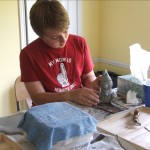
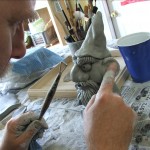
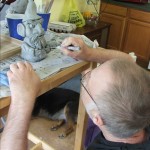
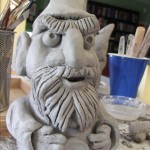
Asked what I’d like for Mother’s Day, I responded, “Let’s make garden gnomes!”
So that’s what we did. Down we sat, clay and tools in hand, in a sunny yellow kitchen overlooking our beloved garden. Armed with imagination, a few handy hand-building techniques and a sense of humor, we all managed to create a gnome worthy of a garden.
It was a great day of art, indeed.



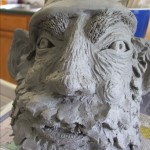
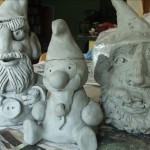
poppies and sketch crawls and rain, oh my!
April 8th, 2009
I am looking forward to Saturday’s 22nd World Wide Sketch Crawl! I thought it might be a good idea to put forth a plan in the event of rain. The Sketch Crawl is designed to take place rain or shine. You’ll just get to set up shop inside and sketch (maybe over a nice cup of tea?) to your heart’s content until you decide you’re ready to move on to another location or call it a day.
If the rain is pouring down at the start time of 10:00 a.m., let’s just meet up across the street from the south entrance to the courthouse at Down the Alley Bistro. It’s a nice establishment – a good place to start our adventure that day!
Otherwise, I’m crossing my fingers and hoping to have a beautiful day! Please spread the word, and bring a friend or two! Read my previous post for details about his wonderful day.
By the way, if you are available on Friday the 10th at around 10:00 a.m. and are looking for something fun to do, join me, Karen Frost from the City of Georgetown, and a host of other daring artists as we paint poppies on the business windows on the square! We’re doing this to prepare for the Red Poppy Fest at the end of April, so come join in the fun! We’ll provide paint, bring a brush, a cup, and a drop cloth or tarp if you have one! Don’t worry if you haven’t painted a poppy before, we’ll help you along!
Got art?
copyright ©2008‑2019 carol j watson22nd world wide sketch crawl in georgetown, texas!
March 26th, 2009
22nd World Wide Sketch Crawl April 11, 2009 10:00 a.m. to 2:00 p.m. On the Historic Square in Georgetown, Texas
Meet at the south stairs of the courthouse on the square or join in the fun with sketch crawl participants where you find them!
Help create a sense of community for those of us who love art and want to share our enthusiasm with others. Network with one another. Have fun!
What should I bring? Art materials include (but aren’t limited to) sketchpad or sketchbook, favorite pencil, eraser, drawing pen, maybe watercolors or colored pencils – your media, your choice!
Other items that might prove useful include a water bottle, money, a small comfy folding chair, weather related clothing, camera.
Who should attend? Artists of a wide range of ages and abilities are encouraged to attend. Because of the nature of this event (being stationary, observing, focusing, drawing), bringing very small children isn’t recommended. They simply require too much attention for you to be able to participate fully.
Is there a schedule for this event? A sketch crawl is a casual affair. Arrive at 10:00 a.m. or arrive whenever! Those of us who are at the south stairs at 10am will converge upon the square for whatever length of time is comfortable. Participants may travel and sketch in small groups, pairs, or alone. Those who are interested in breaking at lunch may do so and choose from a wide variety of restaurants on or around the square. You can even use your lunch break as another drawing opportunity! At 2pm, reconvene at the south stairs of the courthouse. We’ll share and celebrate our drawings, and get additional information on how to access the forum at www.sketchcrawl.com, including how to scan and upload our drawings and/or pictures to the sketch crawl site (for those who might be interested in doing that). After 2pm, the sketch crawl adventure can continue for those who wish to do so!
What else should I know about this day? Saturday, April 11, 2009 is also a Market Days on the Square in Georgetown. Vendors will be set up around the square, and lots of people will be shopping, eating and strolling around the square. There will be tons to see and draw! Take advantage of the side streets and some alleys for additional points of interest.
For more information about Georgetown
Here be the Google Map
I look forward to seeing you there!
copyright ©2008‑2019 carol j watsoncreative energy put to good use
March 19th, 2009
Spring is definitely here. My favorite color, the ender green of springtime, is everywhere. My Jeep matches Mother Nature, and I love it! Blessed with beautiful Spring Break weather, my family has taken full advantage of it: Washing the Jeep, taking the top down, working in the garden, putting up the long-awaited purple screen door (more on that later), painting, sweeping, napping with the windows open and watching our precious cats mesmerized by birds and bees they see through the latched screen door.
For Spring Break 2009, I had grand illusions of days and days of uninterrupted art, though. I have beads to create, jewelry pieces to design and a canvas just screaming at me from its lonely easel post in the kitchen. So what happened to my creative energy? That’s simple. I diverted it to creative tasks (blessings?) around the house.
As we hung the screen door, as I painted the window in my master bath, as I spray-painted an antique chair and created a new and purple-y focal area by my front door, I thought a lot about creative energy. About creating art. About what art is and what it isn’t. I concluded that the creative and artistic energy that flows from us isn’t confined to being appreciated in a drawing or bead or sculpture. It’s the artful life we lead; it is the artful approach we take to creating the world in which we live. As I worked around the house, I used creative energy no differently than if I were working on the torch or at the easel. The main difference I see is that my accomplishments at home can’t be sold on Etsy or displayed in an exhibit somewhere. Not likely, anyway.
What this means to me is that whether we see ourselves as traditional artists or not, we all can lead our lives artfully. We can pour our creative energy into the world around us, our communities, our schools, our neighborhoods and our homes. I’m pretty sure someone has already written this book, and yes, I know I’m stating the obvious, but it seems like something worth saying over and over again.
I wish you a creative Spring.
copyright ©2008‑2019 carol j watsoncreativity tastes good
January 16, 2009
In addition to adoring the artistic creative process, I love the creative force behind gardening and the natural world. For most of 2008, I wasn’t able to do much gardening, at least not compared to previous years. However, our citrus trees (lime, lemon, orange) continue to be a source of delight and satisfaction. While we burned through our limes long ago, our lemons and oranges are just now blessing us.
I just had to take some pictures.
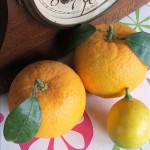






of chairs and scale
January 12, 2009
My husband, Arden, and I had an opportunity to attend a recent retreat for board members and volunteers of a wonderful and local non-profit organization called Georgetown Art Works. Our goals were simple: Clarify our vision as an organization, write (or at the very least agree upon the basics of) a mission statement, work on our 2009 calendar and designate specific responsibilities and opportunities for each of us in attendance. We had an incredible facilitator, a dedicated board president, plenty of food, great ideas and most importantly, a creative outlet. We made incredible progress.
The creative outlet, which was strictly optional, was to design a chair made from various materials: Pipe cleaners, wire, beads, and imagination. As we listened, ate, talked, prioritized, laughed and became better acquainted with one another, we also created a chair representative of us and our task at hand of “chairing” some event or ask.
By the end of the retreat, several completed chairs were passed around for oohs and ahhhs. Oh, how I wished I had brought my camera! Each chair was indeed unique, representative of its creator and just spilling over with artistic genius! The funniest and certainly most endearing, moment was when my husband and I placed our chairs side by side. If you know us, you’ll love this picture (I snapped this picture at home):
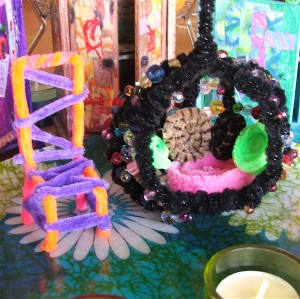
While mine was, well, what you might expect from me, Arden’s (left chair) was delightfully sturdy, stable, well-made… also what you would expect from him. I love the contrast the two chairs created but it wasn’t until we showed the chairs to our son, Carter, when he commented on their scale. The way he put it was something like this, “Whoever can fit into one chair can also fit into the other, isn’t that cool?” Pretty astute for a 13 year old, I think. What he hit upon is that our chairs shared the same scale. And in that moment I realized that our chairs were a perfect snapshot of our life together, me and Arden. Some similarities, some differences… well, maybe a lot of differences to those who only look at he outside, but we live our lives in scale with one another.
Perhaps that accounts for the harmony we so often experience in our household, even in these tumultuous times.
At any rate, this art activity ran deep and wide for me. I learned a lot that day of the retreat but even more about myself, my love and our life together later on.
Art is like that. It mirrors your reality, makes things clearer, gives voice to your life and times.
Art is worth doing.
copyright ©2008‑2019 carol j watsonconvergence bead set #3
January 4, 2009
I love working with blue/brown glass combinations. Doing so is the lampworking equivalent of jeans and a soft turtleneck sweater on a rainy day. There’s something so maternal and genuine in this combination, perhaps because they are the essence of earth and air, soil and sky. Visually, these beads are versatile in terms of fashion and jewelry design applications. This beadset features moretti glass of cobalt, blue, periwinkle, sky blue, blue aventurine, brown, topaz, aupe and ivory. Transparent light blue and topaz lend three dimensionality to many of the beads and a variety of shapes and designs are highlighted in this set.





another convergence bead set
January 3, 2009
This set features variations of brown, taupe, topaz, red, yellow and ivory. I used both opaque and transparent glass, the latter of which creates the layered look in several of the beads. This was a new color combination for me and I enjoyed working with it. Warm, organic, and honeyed, the end results are reminiscent of harvest time. Beyond that, the red glass brings out something primal and corporeal in the color combinations.
Blood and Honey.






convergence
December 31, 2008
I am working with jewelry designer/metalsmith extraordinaire, Jane Estes, on the International Society of Glass Beadmakers’ Convergence Project. The fundamentals of this competition are that two artists are paired, a lampworker (that’s me) and a jewelry designer (that’s Jane), to created a wearable object of art that is inspired by the four elements of water, air, earth, and/or fire.
We’ve been planning, brainstorming, sketching in our notebooks and visiting each other’s studios in order to learn more about one another’s style, ideas, art form, and expectations. It has been exciting to collaborate with another artist on a project and we have gotten off to an incredible start despite one hip replacement surgery (me) and 4-year old twins (Jane)! I have found Jane to be a fountain of inspiration with an incredible eye for style and design. My most memorable moment so far has been watching Jane play with and pick out colors from my glass inventory, creating a palette from which I would create glass beads. Pulling out the pretty rods of glass is sort of like opening a brand new box of crayons, but without the fabulous smell. It’s good.
So far, I’ve experimented with nails and screws in glass beads (see last month’s posts) and I’ve really enjoyed creating the most recent Earth and Water inspired bead set which I will feature below. Next, I am going to focus on truly Earthen tones, and see what inspiration is derived therein.

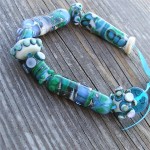

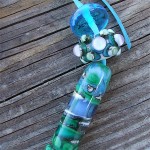
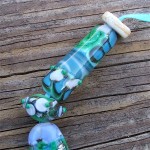

finished the shrines… for now
December 26, 2008
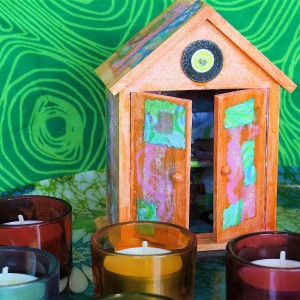
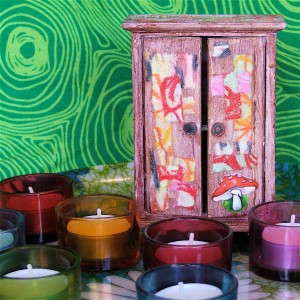
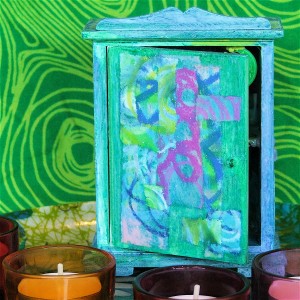
Whew! I finished! These were fun little projects. I gave two away as Christmas gifts before I could take pics (hmmm, mental note to self: sneak them back for a picture). Four are left though, and they are going up on Etsy as soon as I am done with this post.
I say that these shrines are finished for now because they really are intended for completion by the owner. While I put a few embellishments inside, I was mindful to leave room for purposeful things to be added later. Each one definitely took on a personality of its own, but even that is destined to evolve in the hands its owner.
So, what did I do in these final stages? Well, first, I decided it was time for more hand-designed paper, so out came the rice paper, watercolors and oil pastels. That is a therapeutic activity perfect for whiling away the time (even better if Ellen is on). I drew shapes and designs on rice paper with the oil pastels, then went over the entire paper with watercolor (Prang™ glitter watercolors are my favorite). Then I just tore various rectangles, squares and odd shapes with my trusty metal ruler.
I used more satin finish varnish to seal everything on the outside and added more than just the decorative rice paper. I used stamps, fortune cards, and my favorite, precious die-cut gnomes from Tiny Things are Cute. I added some 3D features with various small embellishments and even some leftover multicolor shrinky dink rectangles left over from a previous project.
Last, I gave a light sprinkle of sugardust white glitter. I love it: Glitter. I love working with it. I love how when I finally quit for the night, I have glitter in random and accidental places. I love how the next morning, it is in my bed on and in my husband’s sideburns. Glitter migrates. No one is safe from the glitter.
Now all I have left to do is upload the shrines to Etsy. I’ll post more pictures there. For now, enjoy!

shrines, continued
December 12, 2008
Now I have added some color to the shrines. I used ink on top of the gesso for a nice layered and transparent look. I blended colors that I liked and even had quite a bit of fun using brown. It rounds colors out nicely. Still not sure of their content, I use “assembly line” time for quiet contemplation. It is still too early for me to tell what each of these little cabinets will become.
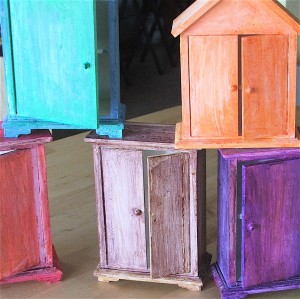
So far, I’ve colored six shrines (not all are pictured above).
Next, collage. I decided not to use ink on the inside, because (1) I have a limited supply and (2) I have an abundant supply of paper to use instead. Anyway, I love collage, and I think it makes the inside of each shrine a bit more special and secret and important. As I worked, I allowed only color to drive me. No hidden messages, no theme yet for any of the shrines. I am toying with the idea of leaving them be, and making them available for people who wish to further customize them to their own ideas, people, messages, or causes.
The purple one remains empty at this time. It is my favorite one so far, and I just haven’t worked up the creative juice for it yet.
The brown-yellow one surprised me because when I was finished looking with it and actually looked at it as a piece, not a project in process, there was something of a message. The words bite, real estate, and crime all appear in text that I thought I was randomly adhering with varnish. Subliminal, for sure! Definitely not intended, though.
My papers that I use come from a variety of sources:
- hand painted rice paper (so nice and thin), with watercolor, ink, and oil pastel
- commercially available crafting or scrapbook papers
- spanish language newspapers
- old novel pages
- old encyclopedia pages
- tags
- receipts
I just save cool stuff and then tear it up to use in my mixed media and collage pieces. I also use the papers to customize bar soap boxes to hold my Etsy items that sell when I mail them out. Very customized packing!
Here’s where I am now:
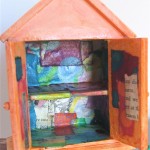
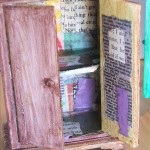
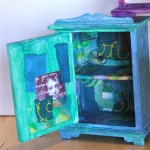
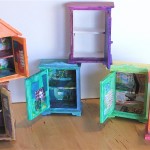
Next for me is to figure out the path of the purple shrine…
copyright ©2008‑2019 carol j watsonsomething new
December 8, 2008
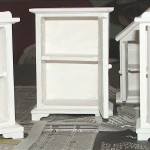
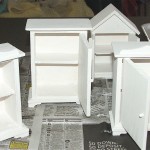
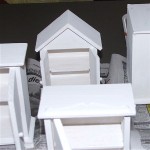
I am beginning my work on personal shrines. I’ve been sketching out ideas for design but haven’t given much though to content yet…a mere list in my sketchbook at best. I want these prefab balsa cabinets to really take on a life of their own through the various media I plan to use but I also want them to evoke emotion, because, after all, they are shrines. I see shrines as a venue for honoring an idea, a memory or special time in one’s life.
Previous shrines I’ve made have been from matchboxes (small and large), as well as from objects such as Laughing Cow™ containers or soap boxes. The soap boxes smell good.
Humor, passion, art and strength will feature prominently in these personal shrines. I am tempted to create one or two to honor the memory of my father, who passed away in 2007 from brain cancer or commemorate the life of my grandmother, still living a shadow life with Alzheimer’s. I’ve used my art a lot in the last two years to work through my grief so I am not sure that I need to address them again with these particular shrines. But as always, we’ll see…
I plan to use ink, collage, and personal drawings heavily. I also have some tiny adornments that might work as well as some copies of old photographs. I’ll post updated pictures as I have them. For now, here’s what I have so far, just a little gesso. Enjoy!
charismacolors
December 8, 2008
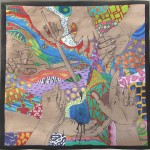
Here’s a project I did with my Art I students earlier this year, pre-surgery. We were studying gesture drawings, composition, foreground, background and I was attempting to fully indoctrinate my students with a love, respect and appreciation for prismacolor pencils. Yum. Or, as one of my students calls them, “Charismacolors.”
Yes. Indeed, that is exactly what they are.


creative stirrings
December 4, 2008
For the last week or so, my life has been focused primarily on painkillers, sleep, and physical therapy. All good. All helpful. I’m glad my surgery was successful, and I am profoundly glad to be home. Thanksgiving dinner at the hospital did not suck, by the way. Quite tasty.
I know I’m feeling better in significant ways because I’ve felt some creative stirrings today. Specifically, I woke from a nap with a slew of ideas and as soon as I am done crowing about that fact I will be sketching and writing my nap ideas out.
To that point, I have gotten several really key inspirations after a good stretch of sleep. I know that when I am worried, sleep-deprived or feeling down, my creativity takes a serious hit. Rest is good. My husband is the ultimate nap artist, and he will be so proud to read this admission: Naps are Good.
Speaking of naps, I shall now snuggle up with my sketchbook and attempt one more nap before dinner…
copyright ©2008‑2019 carol j watsontaking advantage of “down time”
November 23, 2008
As most people who have looked at this humble blog probably already know, I will be going into the hospital this week for a much needed hip replacement. At 39, this is an unusual thing, so I expect to urn a few heads in the joint replacement ward. But, it is what it is. I feel thankful to live in a time when my ailment is so easily corrected. I look forward to being able to walk normally again, without a cane, and my students (many of whom have only known me this school year and with a cane) had better get ready for the new and improved Mrs. Watson when I return! I also must acknowledge my supportive and loving family, especially my husband and son who have waited on me hand and foot, patiently walked with me while I hobbled to and fro, and in general have made it possible for me to keep working up until this point. I couldn’t ask for more supportive family and friends.
With all that said, let’s talk about ART! Specifically, let’s talk about the art I have been thinking I will do during my recovery period and how this recovery period will affect my art and the creative process. Already, I have been planning some specific art projects and they’ve been defined by what I think will be limiting circumstances: Limited mobility, limited ability to sit (at first), and obviously, limited standing/walking ability (also at first). Working with clay, at least as I’ve done in the past, is out. Standing at an easel, probably also out. Sitting at the torch, making beads, well that I might be able to do in a couple of weeks. So, that leaves me some promising outlets including drawing, small object painting and jewelry making.
I love to make pocketbook/matchbook shrines and I have been gathering supplies for that: Miniature objects and ephemera, papers for collage, pastels, varnish, and paints. I think I will work with those objects first but as to what I will use as my subjects or inspiration, I cannot say. That hopefully will work itself out in the next week or so.
Once I am more mobile, I plan to do some lampwork. I am very excited about this and even on this blog you can see I’ve been feeling very experimental lately. I am collaborating with jewelry designer Jane Estes on the ISGB Convergence Project and Competition, and I hope to get some work done on that project during my recovery period as well.
Lastly, I hope to make some lampwork jewelry from my finished beads. I have been particularly fond of making pendants during the last year or so and quite averse to earrings. Maybe that will change and I will get some earrings made. I would like to include found objects in my designs, so that will be a challenge to my creativity as I work in this category.
So, give me a week or two to get it together after surgery and I hope to post again before you know it. Time flies when you’re having fun, and I intend to have a blast with this new experience. I can’t wait o see its reflection – and expression – in my art.
copyright ©2008‑2019 carol j watsonokay, so it worked
November 17, 2008
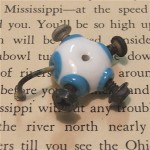
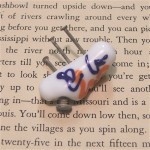
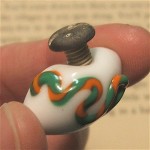
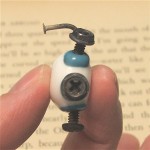
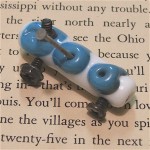
The glass didn’t shatter, the metal didn’t melt. I chalk this one up as a success. These beads are pretty rough but now I see some application for future uses. Hmmm, also I think I may want to play with copper.
And, I need smaller nails, screws, washers, etc. These were really too big, I think, but again, it was only a test. Had this been a real glass and metal event, this post would have been followed by some really cool looking beads.
These will do for now.
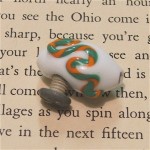

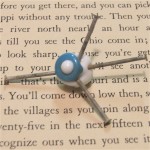
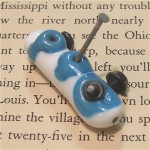
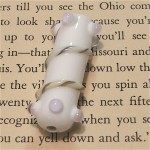
the point of this is…
November 16, 2008
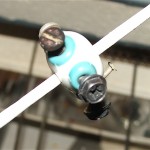
Today I tried something new. I’m sure it isn’t exactly new to some folks out there, but it was new to me. I can’t wait to see how it turns out. I added metals to my glass beads, sort of a steam punk tipping of the hat, you might say. It’s crude and might be a failure come morning, but it has been an idea bouncing around in my head for a while, and so I tried it.
I started with just white glass and small nails and even smaller screws. I tried out tube beads and round beads, elliptical beads and some irregular who- knows beads. I heated the metal parts to make them stick in the glass, and found the whole process to be highly dependent on where in my mouth my tongue was placed. Very scientific.
First I drew the beads in a journal. Well, actually, first I dreamed about the beads, then I drew them in a journal. In my dream, I made the beads and then put them in my mouth. That’s actually an urge I have to beads I make in waking life, so having that happen in my dream wasn’t disconcerting or anything, just a normal response. At least normal for me. I woke from my dream when I put them in my mouth, because in my dream they were like ice, and that surprised me. Yeah. I don’t know what that means, but there it is.
So I drew them. That wasn’t very exciting to me but it seemed necessary. I didn’t feel like coloring them or anything. I liked the pencil look of it. To be accurate, drawing the beads didn’t excite me but I loved drawing the metal implements I planned to use, so I got a kick out of some of it, at any rate.
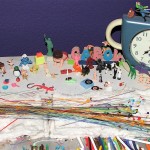
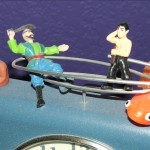
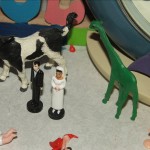
Then I thought about the beads some more, and talked to a friend about them. I talked to my son about them. I talked to my husband about them and then I told my mom. That seemed like enough stalling, so as soon as I rearranged my helpers (see below) on my work table and organized my supplies, I began the process of making the beads of my dreams.
We’ll see how that worked out in the morning.
getting started
November 13, 2008
I’ve been walking around this pond for a while now. I’ve studied the shoreline, the reedy grasses nearby. I’ve taken stock of flora, of fauna, and I’ve watched as her visitors have come for a drink and then quietly gone. Yet I have remained detached, mostly. I think it might be nice to take a dip, skip a stone or even drink from it, and I am almost certain that the pond will welcome me.
So, join me as I test the waters. It looks like a great day for a swim.
 copyright ©2008‑2019 carol j watson
share



follow carol




copyright and license
Copyright ©2008–2019 Carol J. Watson
All Rights Reserved In The World, Universe and Cosmos

Content by Carol J. Watson is licensed under a Creative Commons Attribution-NonCommercial-NoDerivatives 4.0 International License. The most prudent way to share this content is just provide a link.
about carol
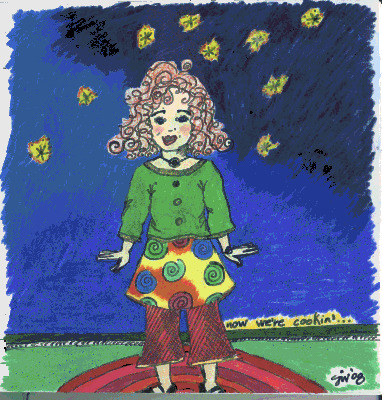 Raised by a pack of she-wolves and taught ancient glasswork techniques by the late and wildly infamous Flora de Belier Monte, Carol continues to evolve in her art and expression. Her glass beads, jewelry, art, and writing reflect her bohemian past and gifts of intuition and imagination.
colophon
Body typeface is Linden Hill, principal design by Barry Schwartz. Linden Hill is a revival of Frederic Goudy’s Deepdene with roman and italic styles. Heading typeface is specified as Cabin Condensed SemiBold, principal design by Impallari Type. See typeface notes.
Header graphic is a hint of the original WP theme from Rastislav Elias when website was originally built with WP, way, way back in the day. Only Carol’s content remains, all website code summarily vaporized into floating charred bits swept away across the ethers, the entire site rebuilt from scratch. Header graphic is built with typefaces Linden Hill and Cabin Condensed SemiBold.
tech stuff
Notably and specifically, this website is designed to render awesomely only on the very latest modern browsers. No real rails here, meaning no clever detecting and alerts of ancient browsers, hand-holding, and comforting. Either the site will look awesome or not. Older stuff may implode into a shower of disappearing pixels. But you’re not running out-of-date, not-secure, quirkish browsers, right? More on how your browser stacks up is here.
A hearty thanks shout out to all of the fine toolsmakers and brewers of powerful magic and goodness mentioned herein forthwith. Here be our accolades: Content written in Markdown, processed by MultiMarkdown then plowed, tilled, forged, assembled, bundled, and bolted together with Arden Henderson’s quantum-powered, time-and-space-bending ksh scripts baked endlessly in our vast coding ovens, afterwards served up piping hot by OpenBSD’s httpd rumbling under OpenBSD. CSS3 spindled, slice, diced, and mercilessly crushed with Sass. HTML5 scrubbed with Tidy. Inkscape used to preemptively bulldoze SVG files. Then, SVG and PNG files scrubbed, pulverized, and then melted into molecular wafer-thin shards with the million-ton steel presses scour and pngcrush, respectively. Certificates provided by Let’s Encrypt™. TLS/crypto stack is LibreSSL. Rock-solid hosting by ARP Networks.






This site is responsive design, 100% static, well-formed XML, studiously crafted in XHTML5 (XML-serialized HTML5 aka polyglot markup), and CSS3, delivered encrypted by HTTPS via IPv4 and IPv6, and fortified with DNSSEC goodness. Robots cheerfully delivered by code from RoboHash, created by Colin Davis. Web page hashes spun up with our own arbitrary pre-processed hashing machinery. Bushels of favicons for herds of devices generated by RealFaviconGenerator. Nary a snippet of JavaScript or any other such mad thing served as far as the eye can see. And no JavaScript hiding in the SVG files, either. We leave it as an exercise for the reader to compare and contrast “well-formed XML” with “valid XML.”
a bunch of validation
TLS validation courtesy of Qualys. XHTML5 and CSS3 validation by W3C. HTTP resources checked via REDbot created by Mark Nottingham. IPv6 validation courtesy of ipv6-test.com. DNSSEC validation courtesy of Verisign DNSSEC Debugger.







That’s the end of the tech stuff section for now. Sad? Looking for good treadmill reading material? Safe sleep aid? See more exciting tech remarks, notes, secret algorithms, and recipes for magical pumpkin pie code in the under-the-hood page.
attributions and other stuff our lawyer robots make us say
After our vast army of lawyer robots perused reams of trademark pages and correspondence, we’re pretty sure use of all the logos above is cool. It is explicitly noted that use of any logos here is not an endorsement or certification or any other such thing by the related organizations. All trademarks within are property of their respective holders. Here be the logos and brands acknowledgements, attributions, and references: Sass brand guidelines. W3C Scalable Vector Graphics Logos and Policies. OpenBSD Puffy and LibreSSL graphics license. Let’s Encrypt™ trademark policy. RedBot website bitmap logo reference teleported to SVG format by Arden Henderson and used with permission provided by @redbotorg. ARP Networks logo provided by Support. IPv6 badge provided by ipv6-test.com. Original artwork HTML5✔, CSS3✔, HTTPS✔ SVG graphics created by Arden Henderson, covered under this web page’s copyright and licensing.